Nationwide SmartRide®
- 4.4
- Rating
- 100.00K
- Installs
- Free
- Price

 Analysis by App-foxy
I approached Nationwide SmartRide® as something that should earn a permanent place on my phone, not merely create curiosity during the first few drives. Developed by Nationwide, this free Auto & Vehicles app is built around a simple promise: help eligible drivers save on auto insurance by taking part in the SmartRide program. That makes it different from a normal navigation tool or a general driving assistant. Its value depends less on how often I open it and more on whether its driving information remains useful over time.
The first impression is easy to understand. Instead of asking me to change insurers immediately or compare a long list of policies, the app connects everyday driving behavior with a potential insurance benefit. That can make the idea feel practical: I continue driving, the app records the relevant activity for the program, and my driving history becomes part of an insurance conversation. The appeal is strongest for someone who already has Nationwide auto insurance or is considering it and wants a more behavior-based route to savings.
Its audience is also fairly clear. This is not an app I would recommend simply because someone wants a polished dashboard for their car. It is aimed at drivers who are comfortable participating in a usage-based insurance program and who understand that the trade-off involves sharing driving information in exchange for the possibility of a better insurance outcome. That exchange deserves a thoughtful decision, rather than a quick installation.
You May Also Like

 Google Keep - Notes and lists
Google Keep’s Quiet Growth Shows the Appeal of Simpler Notes
As mobile work gets busier, Google Keep keeps winning a simple contest: capture a thought quickly, find it later, and get on with the day.

 Blood Strike: 2.5 Anniversary
Blood Strike’s Loadouts Turn Every Drop Into a Tactical Gamble
A close look at Blood Strike’s custom loadouts: how fast access to signature weapons reshapes its battle royale rhythm, rewards preparation, and narrows the gap between fights.

 Pandora - Music & Podcasts
Pandora’s Music Is Easy to Start, but Harder to Recover
Pandora’s strength is its low-effort path from a seed to a station. Its weak spot is how much confidence it asks you to place in connection, setup, and quiet recovery.

 8 Ball Pool
 Is Built on Rivalries, Rematches, and Routine
A close look at the rivalries, rematches, shared routines, and unanswered safety questions that turn a quick pool match into a persistent mobile community.

 Samsung Music
’s Quiet Strength Is Playing What You Already Own
Its reach comes less from spectacle than from dependable access to a personal library. That simplicity is both the app’s strongest retention engine and its ceiling.

 AccuWeather: Weather Radar
AccuWeather Review: A Quick, Clear Forecast for Everyday Decisions
For everyday plans, the best forecast is the one you can understand quickly. AccuWeather makes rain timing, radar, and local conditions easy to act on, with a few trade-offs.
More From Our News Desk



What the first week feels like
During the first week, the most useful mindset is to treat SmartRide as a background companion to normal driving. I would not install it expecting entertainment, constant interaction, or a long list of manual controls. The important part is establishing a consistent routine and letting ordinary trips provide the context the program needs. That makes the app feel less like a destination and more like a participation tool.
A realistic example would be a driver who commutes during the week, makes a grocery trip on Saturday, and occasionally drives to visit family. With a conventional insurance app, those trips might only matter when I need an insurance card, a claim resource, or account information. With SmartRide, the driving itself becomes relevant. The first week is therefore less about exploring screens and more about understanding how the program fits into trips I was already going to make.
One practical tip is to avoid judging the experience after a single short journey. A brief drive can feel inconclusive, especially if I am still learning how the app behaves alongside my phone, vehicle, and usual routine. I would give it a reasonable run of normal trips before deciding whether it is convenient. At the same time, I would not alter my driving in an artificial way just to create a better-looking record. Safe, predictable driving is more important than trying to optimize every individual journey.
The app’s store presence gives it a reassuring level of adoption: it has a 4.4 average from around 1.2 thousand ratings and more than 100 thousand installs. Those figures suggest that it is not an obscure experiment, although they do not remove the need to decide whether its insurance arrangement suits me. I read that reception as evidence of a workable concept, not as a guarantee that every driver will enjoy the same experience.
Setup is where I would pay close attention. Any driving-monitoring service needs to fit into the way I use my phone, and small interruptions can undermine the whole idea. Before relying on it, I would check that the app is ready for my regular trips, that my phone is carried consistently, and that I understand what participation means for my policy. If I share a car with another driver, I would also think through whether the recorded journeys could be confused with someone else’s driving or whether the program has a way to distinguish them.
That last point is more important than it may seem. A household with one primary driver and one occasional driver has a different practical situation from a household where several people regularly use the same vehicle. SmartRide may be a natural fit for the first household, while the second should spend more time understanding how participation works before treating the app as a reliable measure of one person’s habits.
The first-week appeal comes from turning an abstract insurance discount into something I can participate in through normal behavior. I do not need to remember to enter every trip manually, and I do not need a separate gadget sitting on the dashboard. However, convenience depends on my willingness to let the app remain part of my driving routine. If I dislike that kind of ongoing involvement, the initial novelty will fade quickly.
Where the savings idea becomes practical
The strongest reason to keep using the app is the possibility of reducing the cost of auto insurance through Nationwide SmartRide. That possibility is more compelling for drivers who already drive carefully and consistently. Someone who expects their everyday driving style to support the program may see the app as a low-effort way to make that behavior count toward insurance.
I would be cautious about treating the app as an automatic discount button, though. Insurance savings are tied to the program rather than to simply having the application installed. A driver should read the participation terms and understand how the result affects their own policy before making a financial decision. The app can support that process, but it cannot replace a careful look at coverage, eligibility, and the overall cost of the insurance plan.
This is also where comparison with usual alternatives matters. A traditional insurance policy may be simpler for someone who values predictable administration and does not want driving behavior involved. A standard insurer app may offer account access without asking me to participate in a monitoring program. On the other hand, a generic driving tracker may provide trip information but have no direct connection to an insurance benefit. SmartRide occupies the middle ground: it is more purposeful than a basic trip log, but more personal and potentially more demanding than ordinary policy management.
For me, the right comparison is not “Which app has more screens?” It is “Which arrangement matches my priorities?” If I want the chance to turn careful driving into insurance value, SmartRide has a clear reason to exist. If I want maximum separation between my driving habits and my insurer, a conventional policy may be the better choice even if it offers fewer opportunities for behavior-based savings.
Month-to-month value and the cost of staying engaged
After the first month, the app’s novelty matters much less. I am no longer discovering the concept; I am deciding whether the routine continues to justify itself. The recurring value comes from keeping participation active and allowing the program to reflect a broader slice of my normal driving rather than a short burst of attention.
This is a useful distinction. Many apps are valuable because I open them every day. SmartRide can be valuable even when I rarely look at it, provided it is functioning as intended and supporting my insurance participation. That makes it closer to a financial habit than a conventional mobile service. I would judge it by the result of staying enrolled and driving normally, not by the amount of time spent browsing inside the interface.
There is a subtle behavioral advantage here. The presence of a driving-monitoring program can make me more conscious of habits that I usually ignore, such as rushing between errands or treating every short trip as inconsequential. That awareness may encourage calmer driving, but I would not want the app to make me anxious behind the wheel. The best outcome is a quiet reminder to drive responsibly, not a reason to stare at the phone or second-guess every moment on the road.
My recommended workflow would be simple. I would review the app occasionally rather than after every journey, confirm that participation still makes sense for my insurance situation, and use any available information as a prompt for broad habits instead of obsessing over isolated trips. This avoids turning a potentially low-maintenance insurance tool into another daily task.
Drivers should also think about changing circumstances. A new commute, a move to a busier area, a different vehicle, or a household member using the car more often can change how comfortable the program feels. The value is not fixed forever just because the first month went well. I would revisit the arrangement whenever my driving pattern changes substantially, especially if the app begins to feel less representative of the person or trips I expected it to cover.
The recurring value is strongest for a stable driver with a stable routine. Someone who drives regularly, keeps their phone with them, and is comfortable with the program’s monitoring approach is more likely to see SmartRide as background infrastructure. Someone with irregular vehicle access, frequent passenger driving, or a complicated household arrangement may find that the administrative questions outweigh the potential benefit.
Maintenance is small, but not invisible
Calling SmartRide low maintenance would be fair, but calling it maintenance-free would not. The app needs to remain compatible with my phone and fit reliably into my driving routine. I would keep an eye on whether trips are being recognized as expected, whether my phone habits have changed, and whether an operating-system update or device replacement affects the experience.
The minimum operating system is Android 10 or newer, so anyone using an older Android phone should check compatibility before planning around the app. The current version is identified as nwsmart-v4.4.0.0-98115-g88ef6c5-prod, which is useful when checking whether my installation is current or when describing a technical issue to support. I would not treat a version number as a reason to update blindly, but keeping the app current is sensible for a service tied to insurance participation.
One non-obvious maintenance issue is phone placement and consistency. Even when an app is designed to work in the background, my own habits still matter. If I regularly leave my phone at home, switch devices, use a work phone for some trips, or change how I travel, the record may no longer represent my normal driving. The practical lesson is to establish one dependable routine rather than repeatedly troubleshooting after the fact.
Another useful habit is to separate safety from app management. I would never handle the phone while driving to check a trip or investigate a notification. Any review of the app belongs before leaving, after parking, or when safely stopped. A program intended to encourage responsible driving should not introduce a new distraction through overchecking.
There is also an account-management burden that is easy to underestimate. Because the app is connected to an insurance program, I would keep my policy details and participation status in mind rather than assuming that the mobile installation tells the whole story. If I change vehicles, policies, or the people who drive the car, I would contact Nationwide through the appropriate channel and confirm what needs to be updated instead of relying on the app to infer everything automatically.
That is the main maintenance trade-off: the app may be quiet most of the time, but the consequences of ignoring it can be more important than with an ordinary lifestyle app. A missed update or misunderstood participation detail could matter because the service is linked to insurance. I would therefore recommend occasional check-ins, not constant attention.
What can cause fatigue over time
The largest source of fatigue is the feeling of being evaluated every time I drive. Even careful drivers may dislike the idea that ordinary journeys are part of an insurance program. If that discomfort grows, the possible savings may no longer feel worth the mental cost. This is not a technical flaw; it is a personal boundary, and SmartRide is not the right choice for everyone.
Fatigue can also come from ambiguity. If I am unsure how a trip was interpreted, how another household driver affects the record, or how participation connects with my policy, I may start checking the app too often. Clear expectations are essential. Before committing, I would make sure I understand the program’s terms and know where to ask questions. That preparation is more valuable than repeatedly opening the app in search of reassurance.
Irregular schedules create another challenge. A driver who alternates between several vehicles, frequently borrows cars, or changes phones may find the routine less dependable than a driver with one car and one device. Likewise, someone who drives mainly in unusual conditions may not feel that a standard sample of trips reflects their everyday choices. In those cases, I would compare the potential insurance value with the inconvenience of maintaining a clean, understandable participation pattern.
There is a social source of fatigue as well. Passengers may ask what the app is doing, household members may be unsure whose driving is being represented, and family discussions about driving behavior can become uncomfortable. I would explain the arrangement before sharing a vehicle regularly. That conversation is not just about privacy; it prevents misunderstandings about why the app is installed and who is expected to use the car.
For drivers who already feel stressed in traffic, a monitoring program may amplify that stress. I would skip SmartRide if the thought of being scored or observed would make me drive tensely, brake unpredictably, or focus more on the phone than the road. The safest insurance decision is not necessarily the one with the most attractive possible discount. A calm, suitable policy can be better than a theoretically cheaper arrangement that changes how I drive.
Who should keep it and who should move on
I see the best fit in a Nationwide customer who drives regularly, uses a compatible Android phone, is comfortable with a usage-based insurance arrangement, and prefers a chance at savings over complete simplicity. The app is also worth considering for a careful driver comparing insurance options and willing to evaluate the whole Nationwide policy rather than focusing only on the SmartRide element.
I would be more hesitant for someone who wants an insurer app only for documents, payments, or claims. SmartRide is not compelling merely because it is free. Its purpose is participation in a driving-based program, so a person who does not want that relationship should choose a conventional insurance setup instead.
I would also advise caution for households with many drivers and vehicles until the participation details are fully understood. The same applies to people who change phones often, drive only occasionally, or expect every journey to be interpreted in a way that feels perfectly transparent. Those users may prefer a normal policy app or a non-insurance driving tool, depending on their goal.
The age rating is Everyone, which reflects the app’s general accessibility, but that does not mean every driving situation is equally suitable. The important question is not whether a family member can see the app in an app store; it is whether the insured driver understands the program and can use it without distraction.
Long-term verdict after the novelty fades
Nationwide SmartRide earns lasting space on my phone when I treat it as a quiet insurance routine rather than a feature-packed driving companion. Its strongest quality is focus: it connects everyday driving with a possible insurance saving and avoids asking me to manage another elaborate dashboard. For the right driver, that focused purpose is enough.
Its weakness is inseparable from its purpose. The benefit depends on accepting an ongoing relationship between driving behavior and insurance. That can create questions about privacy, household use, phone consistency, and the meaning of the recorded experience. The app is not something I would install casually and forget without checking how it fits my policy.
In practical terms, I would keep it if my driving pattern were stable, my phone setup were dependable, and the potential insurance value outweighed my concern about monitoring. I would review it occasionally, avoid overreacting to individual trips, and contact Nationwide when a major change affected my vehicle, phone, or household drivers. That approach preserves the convenience without turning the app into a source of daily stress.
I would move on if the program made me uncomfortable, if my driving circumstances were too complicated for a clear record, or if a traditional insurance policy offered a better overall balance of coverage, cost, and privacy. The fact that the app is free does not make participation free of trade-offs. My time, attention, and comfort with data sharing still count.
Nationwide SmartRide is therefore a worthwhile specialist app, not a universal recommendation. The first week can be appealing because the concept is straightforward, and the month-to-month value can be real for a consistent, safety-minded Nationwide driver. But its long-term success depends on habit and trust. The lasting benefit comes from a routine I can maintain comfortably, not from the novelty of installing another app.
With its Everyone content rating, free availability, and release history beginning in June 2020, it is accessible to the audience it is designed for. Still, accessibility should not be confused with suitability. I would choose it after comparing the full insurance arrangement and understanding the practical responsibilities, not simply because it offers a modern way to think about auto coverage.
My final recommendation is measured but positive: try it when the SmartRide program matches your insurance goals and your everyday driving is consistent. Give the routine enough time to judge its real convenience, then keep it only if the possible savings and behavioral feedback feel worthwhile. If that balance holds, it can quietly justify its place on your phone month after month. If it does not, a simpler insurance arrangement is likely the better long-term choice.
FAQs for Nationwide SmartRide®
01What is Nationwide SmartRide® and how does it work?
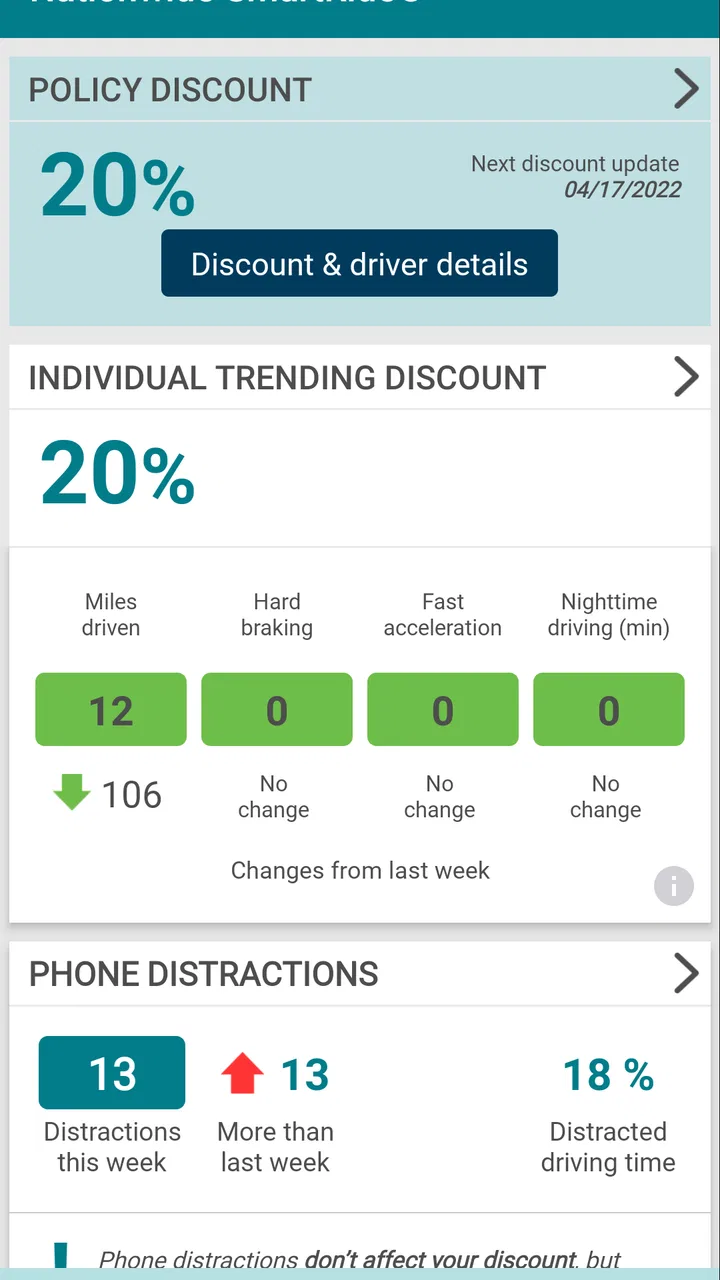
Nationwide SmartRide® is a usage-based insurance program that evaluates driving habits to potentially help eligible customers earn a discount on their auto insurance. After enrollment, the app or connected device may collect information such as mileage, time of day, braking, acceleration, and driving behavior. The collected data is reviewed by Nationwide according to the program’s terms and is used to calculate participation results.
02What information does Nationwide SmartRide® collect from my phone or vehicle?
Depending on the enrollment method available for your policy, SmartRide® may collect driving-related information through the mobile application, a vehicle-connected device, or another approved technology. This can include trips, distance, speed-related information, braking, acceleration, location, and the time a journey takes place. Before enrolling, review Nationwide’s privacy policy and program disclosures to understand how data is collected, stored, shared, and used.
03Can Nationwide SmartRide® lower my insurance premium?
SmartRide® is designed to give eligible drivers the opportunity to receive a discount based on qualifying driving behavior and program participation. Savings are not guaranteed, and the amount can depend on your state, policy, enrollment method, driving results, and Nationwide’s current rules. The program may also have a maximum discount or other limitations, so check your policy details before relying on a specific amount.
04Does Nationwide SmartRide® affect my insurance if I drive poorly?
The program is generally promoted as a way to earn a potential discount rather than as a standard surcharge program, but the exact effect can vary by state, policy, and the terms in force when you enroll. Driving patterns such as hard braking, rapid acceleration, late-night driving, or frequent trips could influence your results. Read the enrollment agreement carefully to understand how unfavorable data is handled.
05What should I check before downloading and using the SmartRide® app?
Before downloading Nationwide SmartRide®, confirm that the program is available for your policy and in your state, and check whether your phone meets the required Android or iOS version. The app may need permissions for location, motion, Bluetooth, notifications, and background activity to record trips accurately. Also review battery usage, privacy settings, data requirements, and whether every driver or vehicle on the policy must participate.
Pros
- Helpful driving insights can encourage safer
- more mindful habits.
- Trip information is presented in a convenient mobile format.
- May help eligible drivers access personalized insurance benefits.
- Useful for reviewing driving patterns over time.
- Designed to work alongside Nationwide’s insurance services.
Cons
- Requires access to driving and location data to provide tracking features.
- Battery usage may increase when trips are monitored in the background.
- Benefits may vary depending on your policy and eligibility.
- Driving scores can feel intrusive or stressful for some users.
- App usefulness is limited if you are not a Nationwide customer.

Nationwide SmartRide®
Gallery